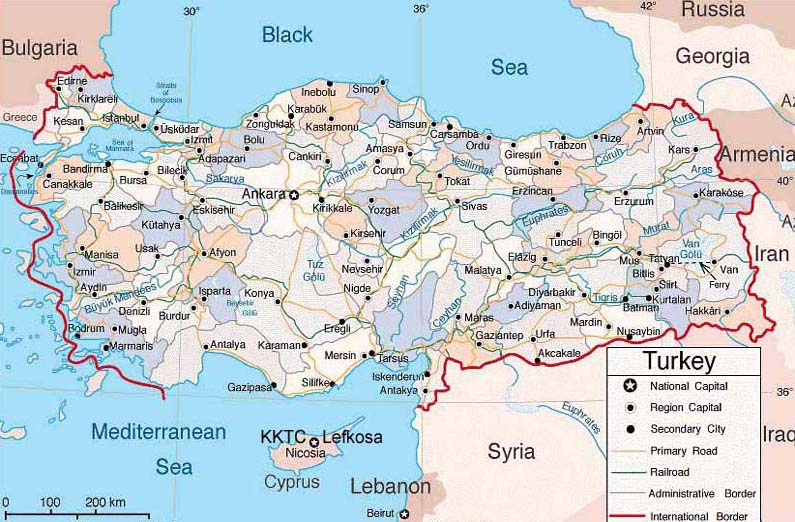
Two friends and I kicked it up a notch, though, in the summer of 2005. We took a cross-Turkey hitch-hiking trip. It was a blast. I have no idea how many kilometers we covered, but if I ever find the map I kept, I'll try to post the route we took. I've linked a map of Turkey, so folks can at least get an idea of the scale. We started in Istanbul, and finished there, having visited Nevşehir, Malatya, Hasan Keyf (not shown), Urfa, Mardin, Batman (no joke, check the map), Tatvan, and then some other obscure places: Doğubeyazıt and Çalderon (basically, this place was Iran), before Diyarbakır, whence we took the train to the 'Bul.
Instead of the full three-week narrative, I'll put this out there in pieces, and I'll try to consult my friends to get up some pictures up, too.
This is a story from Mardin.
By the time we arrived there, we had been traveling for about ten or twelve days, and we had been exposed to a number of new foods, many truck stops, and less than sanitary conditions. We were all ill with something, and I was taking my turn with a stomach illness.
An Istanbullu friend had insisted we contact his family in Mardin, when we got there. On the day in question, a brother-in-law was giving us a tour of a Syrian Orthodox church, The Fourty Martyr's Church (click here for a crappy panoramic tour).
When I see churches in Europe, 'opulent', 'excessive', and 'huge', are all words that come to mind. I hear the message they tried to send to the infidel:
"Our God is a really, really big God, and he can squish you."On the other hand, this church is older, by about five hundred years, than the oldest that I saw in Christendom. It spoke to me that day, three years ago, a message about community, tolerance, peace, and clean bathrooms.
I excused myself from our tour and entered the immaculately white-tiled restroom. Windows, carved into the rock above, illuminated the interior, and while walking through, the contrast of light and shadow danced in the room and from the mirrors. I checked each stall, as I am prone to do with an upset stomach, and found that there were no European-style toilets.
This was a squatty-potty day and it would be messy.
Diarrhea doesn't negotiate, really, so I counted myself lucky to have found a tiled hole, measured against the very real alternative of shitting my pants.
Skipping the details, lets just say I was happy to have gotten up and out of that situation having only soiled my hands. There wasn't any toilet paper, and if you check the picture, you'll notice the faucet at about knee-height next to the toilet. That's a pretty typical feature in Turkish toilet facilities, the idea being that water is cleansing. Indeed it is, and even though I had a wet bum, the alternative was, again, far more uncomfortable. I find that I am often willing to accept a poor option when the only alternative is a horrifying option. Given my overall feeling of discomfort and ickyness, I was really looking forward to a good hand-scrubbing.
I have a former room mate that consistently pointed out to me, that Europeans use paper on their backsides and that this doesn't clean everything. He always joked about European people, referring to them as "shitty-asses". It was cute, and I never bothered to mention that the bidet has a silent "t" because it is a French invention. In any event, water is a big part of Turkish backside-cleansing culture. Use a squatty-potty often enough, and one can learn to enjoy the intimate interaction with one's 'down-theres' that the quest for true cleanliness entails.
As I approached the sink, my heart, dare I say it, felt as though it had been flushed. In front of me were five immaculate sinks (again, there was the light and all that). Each sink had a soap dish, carved into the marble counter, and above each, on the wall, were attached plastic soap dispensers.
All shone with that shiny newness that accompanies never having held soap.



No comments:
Post a Comment