... you say "cheap".
50 Cent is in Turkey this week. Curtis Jackson, in the middle of a performance in the Aegean summer resort of Çeşme, draped himself in a Turkish flag and began holler'in at the crowd:
"When I say Atatürk, you will say respect."
He also went on to ask audience members where he could find some weed.
Hayatimda bu kadar aptal bir hedefi benim memleketimden buraya gelebilecektiğini inanamiyordum.
Or in English, "Why do only douche bags have passports?"
Atatürk is a debatable figure, particularly among the audience that would want to see 50 Cent in concert here. It's hip-hop for god's sake, anti-establishment, anti-authoritarian, and lots of shiny. Bling... bling... come on!
Is it poor planning on the part of his handlers? I seriously doubt Curtis Jackson would knowingly go to Spain and pay his respects to Franco, or give a shout-out to Mussolini in Italy.
It's crap like this that makes it distincly embarrassing for me to be an American living in Turkey. In general, Americans know two things about Turkey:
1. Mustafa Kemal Atatürk (by that I mean his name)
2. A problem with Kurdish people is happening somewhere near here
Many would be hard pressed to find it on a map, because we haven't ever formally declared war on the country, so there's been little media interest.
Just as when Hillary, and later Obama, came to visit, I'll hear about this event for months; from taxi drivers and pastry sellers, and all sorts of people, generally on the right wing of Turkish politics that I prefer not to speak with because most of them will probably echo the same damn opinion. Somehow, this will get sucked into the nationalist rhetoric that I so frequently run into, and I'll be the ass (or worse, really offend someone) for pointing out that Curtis Jackson, in point of fact, is just an ignorant hip-hop star and not really the sort of person a proper Kemalist wants waving the flag around.
Seriously, every time an American gets a hold of a microphone in this country, they take a shot at exposing how fundamentally retarded and ill-informed we can be. I need my insulated, self-righteous indignation and sense of cultural superiority in order to justify continuing to live here. It's just too easy to connect the dots: Curtis Jackson = Tard, and Curtis Jackson = American, thus American = Tard, and in conclusion Sean = Tard.
Thanks a lot Curtis, keep on rockin.
Showing posts with label Tourism. Show all posts
Showing posts with label Tourism. Show all posts
Wednesday, July 15, 2009


Wednesday, May 20, 2009
Not helping things...
I was reading this week that Turkey is using thermal cameras in airports, scanning international travelers who enter the country as part of their entry/passport control procedures. The effort is to detect those infected with swine flu, whose feverish symptoms are easily recognizable in the camera.
Libertarian concerns aside, I think it's a neat idea for finding infected people, ensure that they are treated, and containing the spread of a deadly disease.
Similar cameras are in use at the Bulgarian and Greek border crossings.
A colleague traveled to London, over the weekend, and so I asked her about the entry procedure. As she explained, there are two lines for passport control, one for Turkish nationals and another for foreign nationals. The line for foreign nationals was apparently backed up for hours, because each individual entering through this path had to pass through one of the cameras. However, it is a lucky time for Turks. They don't have to deal with the uncomfortable wait, long lines, or the thermal cameras: the only people being scanned, before entry into Turkey, are those who do not possess a Turkish passport and ID card.
I can only speculate, but the logic must run something akin to: Turkish people are Muslims and Muslims don't eat pork. Thus, Turkish people can't have been exposed to swine flu.
Libertarian concerns aside, I think it's a neat idea for finding infected people, ensure that they are treated, and containing the spread of a deadly disease.
Similar cameras are in use at the Bulgarian and Greek border crossings.
A colleague traveled to London, over the weekend, and so I asked her about the entry procedure. As she explained, there are two lines for passport control, one for Turkish nationals and another for foreign nationals. The line for foreign nationals was apparently backed up for hours, because each individual entering through this path had to pass through one of the cameras. However, it is a lucky time for Turks. They don't have to deal with the uncomfortable wait, long lines, or the thermal cameras: the only people being scanned, before entry into Turkey, are those who do not possess a Turkish passport and ID card.
I can only speculate, but the logic must run something akin to: Turkish people are Muslims and Muslims don't eat pork. Thus, Turkish people can't have been exposed to swine flu.
Saturday, December 20, 2008
Some Links...
I wanted to make the lives of the curious that much easier, and gathered several links about the revolution (not sure what else to call it) in Greece. They include:
Statement by Greek Anarchists/ Anti-Authoritarians
Blog of a British Anarchist
Link to pictures... everything is basically on fire.
There was a call for global solidarity protests today, and I'll be checking the newspapers tomorrow to see if anything happened in Turkey. Last night, as we strolled past the Greek consulate, along the Istiklal, I noticed a police bus parked directly in front of the entrance, several cops dozing inside.
It was a rainy day today, but I do so hope they had to earn their paychecks.
Statement by Greek Anarchists/ Anti-Authoritarians
Blog of a British Anarchist
Link to pictures... everything is basically on fire.
There was a call for global solidarity protests today, and I'll be checking the newspapers tomorrow to see if anything happened in Turkey. Last night, as we strolled past the Greek consulate, along the Istiklal, I noticed a police bus parked directly in front of the entrance, several cops dozing inside.
It was a rainy day today, but I do so hope they had to earn their paychecks.
Sunday, August 24, 2008
Thanks, Elwood.
This evening, as the sun was setting over the western Taurus Mountains, I took a sailboat out on the Mediterranean Sea. It was just a little Lazer, a learner's boat, but it was damn fun!
I haven't been sailing in about four years, when my sister and I took out my uncle's MC-Scow, and proceeded to capsize it multiple time on a blustery day at Cross Lake, in Shreveport, LA. The scow is a squirrely boat, unlike other sailing vessels. Designed with a flat bottom, the pilot is supposed to keep the thing on one keel or the other, for maximum effect.
Anyhow, that was a learning day.
I really learned to sail in a Sunfish on Lake Mauvaisterre, back in Jacksonville, and did a good deal more of it in Copper Harbor, MI, where Elwood and I lived and worked during the summer of 2000. It was mostly Elwood who taught me to sail, so, thanks.
Today's was a new experience. The Mediterranean was especially choppy (apparently, an Agean storm has things stirred up), but the wind was not fast, a steady 6 knots, and I puttered around for about an hour, as far from the coast as I dared venture.
No disco music.
No Russians in tacky bathing outfits.
No absurd job.
Bliss.
I was really rusty though. It's amazing how poorly a person can remember something that they never really learned to do confidently. I breezed of the dock, looked really good doing so, and didn't have any problems until I was about a half kilometer from shore, attempting my first tack. It went so poorly, that I decided to head upwind, and make a long series of close reaches and a lot of tacks for practice. Elwood and I had always tried to milk speed out of our boats, which was really hard in J'ville. Anyhow, the knack came back, and I began to get the hang of dealing with the waves and how to predict what pitching and rolling would do to my speed and direction.
I started to get... confident.
I had been heading southwest, for about a kilometer, and decided to turn around. I set myself up for a long, downwind tack, back in the direction the resort. I was feeling good, smart, and once I began heading east, decided to practice jibing. You know, just to get the hang of it, again.
In my life, I've taken three women out in a boat: my mother, my sister, and my first girlfriend, Kate Nelson. Jibing, a maneuver in which the stern (back) of the boat passes through the source of the wind as it turns, has always been a challenge for Sean. Pulling it off with an extra person consistently proved a disaster, and each of those women I share love with ended up in the water.
Not exactly proud moments.
Like I said though, it was just me, and I was feeling smart.
Of all the things Elwood taught me, knots, maneuvering, reading the wind, the love of sailing...
...today, I am most grateful he taught me how to right a boat.
I haven't been sailing in about four years, when my sister and I took out my uncle's MC-Scow, and proceeded to capsize it multiple time on a blustery day at Cross Lake, in Shreveport, LA. The scow is a squirrely boat, unlike other sailing vessels. Designed with a flat bottom, the pilot is supposed to keep the thing on one keel or the other, for maximum effect.
Anyhow, that was a learning day.
I really learned to sail in a Sunfish on Lake Mauvaisterre, back in Jacksonville, and did a good deal more of it in Copper Harbor, MI, where Elwood and I lived and worked during the summer of 2000. It was mostly Elwood who taught me to sail, so, thanks.
Today's was a new experience. The Mediterranean was especially choppy (apparently, an Agean storm has things stirred up), but the wind was not fast, a steady 6 knots, and I puttered around for about an hour, as far from the coast as I dared venture.
No disco music.
No Russians in tacky bathing outfits.
No absurd job.
Bliss.
I was really rusty though. It's amazing how poorly a person can remember something that they never really learned to do confidently. I breezed of the dock, looked really good doing so, and didn't have any problems until I was about a half kilometer from shore, attempting my first tack. It went so poorly, that I decided to head upwind, and make a long series of close reaches and a lot of tacks for practice. Elwood and I had always tried to milk speed out of our boats, which was really hard in J'ville. Anyhow, the knack came back, and I began to get the hang of dealing with the waves and how to predict what pitching and rolling would do to my speed and direction.
I started to get... confident.
I had been heading southwest, for about a kilometer, and decided to turn around. I set myself up for a long, downwind tack, back in the direction the resort. I was feeling good, smart, and once I began heading east, decided to practice jibing. You know, just to get the hang of it, again.
In my life, I've taken three women out in a boat: my mother, my sister, and my first girlfriend, Kate Nelson. Jibing, a maneuver in which the stern (back) of the boat passes through the source of the wind as it turns, has always been a challenge for Sean. Pulling it off with an extra person consistently proved a disaster, and each of those women I share love with ended up in the water.
Not exactly proud moments.
Like I said though, it was just me, and I was feeling smart.
Of all the things Elwood taught me, knots, maneuvering, reading the wind, the love of sailing...
...today, I am most grateful he taught me how to right a boat.
Thursday, August 21, 2008
False cognates...
My job has taken me away from Istanbul, again, after a four day visit which involved a job interview sandwiched between visits to the Istanbul Police Office (where I applied for and received a residency permit).
Still not sure if I got the job.
I should talk about the residency application process, sometime, but this isn't the post where I want to complain about Turkey's bureaucratic difficulties of Ottoman proportions. I'll just say, I was glad my friends Gregg and Emrah came along. Their commentary made the affair a good deal more fun.
Monday, I took the midnight flight to Antalya (48 minutes), was received by a bewildered driver at the airport ("Sean" sounds distinctly feminine, when Turkish logic is applied to the phonemes. Read it "se-an"), was then driven to Club Salima (50 KM from the Antalya airport), and by 2:30 was settling into my room at a Mediterranean resort.
I was excited!
The veil of expectations, however, was lifted the following morning. Although waking up to the sounds of children, blowing whistles and singing to club music, at 10 AM (which is an early hour, these days), didn't do much for my confidence in a pleasant stay, I think it was a scantily clad, obese Russian family that finally enervated my hopes.
At Club Salima, I'm that guy who thinks the whole place is retarded (or insane, or absurd), and who invariably (I try not to!) exhibits disdain in every movement, spoken phrase, or dip in the sea.
I'm reminded of Bill Murray's character in Lost in Translation, because that is exactly how I feel.
It's been four days. I've gotten to know several of the staff, all good people who seem to have had their nerves frayed by a summer of working with the globe's neediest population: tourists. I've also met some Russian college kids, and though they don't speak any English, they were excited when I smiled at them, said "I like Russia", and gave them a thumbs-up. That, and I bought several rounds of vodka for the lot of 'em (and then suffered the worst hangover in years).
Today really tied it all together. Another beach-goer had seen me speaking Turkish with the staff, and then correctly surmised that I wasn't from around here. This Turkish man was doing his best to figure out what I was doing at a resort for Russians, Italians, and Germans, and tried a little of all three languages before settling into Turkish.
He asked me if I was an animatör.
I didn't understand, what could give him the impression that my line of work involved drawing, much less drawing cartoons. So, I offered him the side-to-side head shake and shrug, which in Turkish means, "I don't understand".
Again, "are you an animator? Do you do animation here at the resort?"
I told him "no", but also asked that he explain. The mimes that this request provoked took me off guard, as the man began jumping from side to side, jazz-hands in the air, smiling like a fool.
Then he said "animation man", several times, and it clicked.
A Turkish animatör is an entertainer.
Still not sure if I got the job.
I should talk about the residency application process, sometime, but this isn't the post where I want to complain about Turkey's bureaucratic difficulties of Ottoman proportions. I'll just say, I was glad my friends Gregg and Emrah came along. Their commentary made the affair a good deal more fun.
Monday, I took the midnight flight to Antalya (48 minutes), was received by a bewildered driver at the airport ("Sean" sounds distinctly feminine, when Turkish logic is applied to the phonemes. Read it "se-an"), was then driven to Club Salima (50 KM from the Antalya airport), and by 2:30 was settling into my room at a Mediterranean resort.
I was excited!
The veil of expectations, however, was lifted the following morning. Although waking up to the sounds of children, blowing whistles and singing to club music, at 10 AM (which is an early hour, these days), didn't do much for my confidence in a pleasant stay, I think it was a scantily clad, obese Russian family that finally enervated my hopes.
At Club Salima, I'm that guy who thinks the whole place is retarded (or insane, or absurd), and who invariably (I try not to!) exhibits disdain in every movement, spoken phrase, or dip in the sea.
I'm reminded of Bill Murray's character in Lost in Translation, because that is exactly how I feel.
It's been four days. I've gotten to know several of the staff, all good people who seem to have had their nerves frayed by a summer of working with the globe's neediest population: tourists. I've also met some Russian college kids, and though they don't speak any English, they were excited when I smiled at them, said "I like Russia", and gave them a thumbs-up. That, and I bought several rounds of vodka for the lot of 'em (and then suffered the worst hangover in years).
Today really tied it all together. Another beach-goer had seen me speaking Turkish with the staff, and then correctly surmised that I wasn't from around here. This Turkish man was doing his best to figure out what I was doing at a resort for Russians, Italians, and Germans, and tried a little of all three languages before settling into Turkish.
He asked me if I was an animatör.
I didn't understand, what could give him the impression that my line of work involved drawing, much less drawing cartoons. So, I offered him the side-to-side head shake and shrug, which in Turkish means, "I don't understand".
Again, "are you an animator? Do you do animation here at the resort?"
I told him "no", but also asked that he explain. The mimes that this request provoked took me off guard, as the man began jumping from side to side, jazz-hands in the air, smiling like a fool.
Then he said "animation man", several times, and it clicked.
A Turkish animatör is an entertainer.
Wednesday, August 13, 2008
"My hands smell like poop."
Expatriate life involves new and exciting experiences for many of the most mundane of daily tasks. I've said before, that the main reason I travel is the puzzle that a new country presents for everyday tasks: using the post office, ordering food, asking directions, brushing my teeth, and yes, using the toilet.
Two friends and I kicked it up a notch, though, in the summer of 2005. We took a cross-Turkey hitch-hiking trip. It was a blast. I have no idea how many kilometers we covered, but if I ever find the map I kept, I'll try to post the route we took. I've linked a map of Turkey, so folks can at least get an idea of the scale. We started in Istanbul, and finished there, having visited Nevşehir, Malatya, Hasan Keyf (not shown), Urfa, Mardin, Batman (no joke, check the map), Tatvan, and then some other obscure places: Doğubeyazıt and Çalderon (basically, this place was Iran), before Diyarbakır, whence we took the train to the 'Bul.
Instead of the full three-week narrative, I'll put this out there in pieces, and I'll try to consult my friends to get up some pictures up, too.
This is a story from Mardin.
By the time we arrived there, we had been traveling for about ten or twelve days, and we had been exposed to a number of new foods, many truck stops, and less than sanitary conditions. We were all ill with something, and I was taking my turn with a stomach illness.
An Istanbullu friend had insisted we contact his family in Mardin, when we got there. On the day in question, a brother-in-law was giving us a tour of a Syrian Orthodox church, The Fourty Martyr's Church (click here for a crappy panoramic tour).
When I see churches in Europe, 'opulent', 'excessive', and 'huge', are all words that come to mind. I hear the message they tried to send to the infidel:
I excused myself from our tour and entered the immaculately white-tiled restroom. Windows, carved into the rock above, illuminated the interior, and while walking through, the contrast of light and shadow danced in the room and from the mirrors. I checked each stall, as I am prone to do with an upset stomach, and found that there were no European-style toilets.
This was a squatty-potty day and it would be messy.
Diarrhea doesn't negotiate, really, so I counted myself lucky to have found a tiled hole, measured against the very real alternative of shitting my pants.
Skipping the details, lets just say I was happy to have gotten up and out of that situation having only soiled my hands. There wasn't any toilet paper, and if you check the picture, you'll notice the faucet at about knee-height next to the toilet. That's a pretty typical feature in Turkish toilet facilities, the idea being that water is cleansing. Indeed it is, and even though I had a wet bum, the alternative was, again, far more uncomfortable. I find that I am often willing to accept a poor option when the only alternative is a horrifying option. Given my overall feeling of discomfort and ickyness, I was really looking forward to a good hand-scrubbing.
I have a former room mate that consistently pointed out to me, that Europeans use paper on their backsides and that this doesn't clean everything. He always joked about European people, referring to them as "shitty-asses". It was cute, and I never bothered to mention that the bidet has a silent "t" because it is a French invention. In any event, water is a big part of Turkish backside-cleansing culture. Use a squatty-potty often enough, and one can learn to enjoy the intimate interaction with one's 'down-theres' that the quest for true cleanliness entails.
As I approached the sink, my heart, dare I say it, felt as though it had been flushed. In front of me were five immaculate sinks (again, there was the light and all that). Each sink had a soap dish, carved into the marble counter, and above each, on the wall, were attached plastic soap dispensers.
All shone with that shiny newness that accompanies never having held soap.
Two friends and I kicked it up a notch, though, in the summer of 2005. We took a cross-Turkey hitch-hiking trip. It was a blast. I have no idea how many kilometers we covered, but if I ever find the map I kept, I'll try to post the route we took. I've linked a map of Turkey, so folks can at least get an idea of the scale. We started in Istanbul, and finished there, having visited Nevşehir, Malatya, Hasan Keyf (not shown), Urfa, Mardin, Batman (no joke, check the map), Tatvan, and then some other obscure places: Doğubeyazıt and Çalderon (basically, this place was Iran), before Diyarbakır, whence we took the train to the 'Bul.
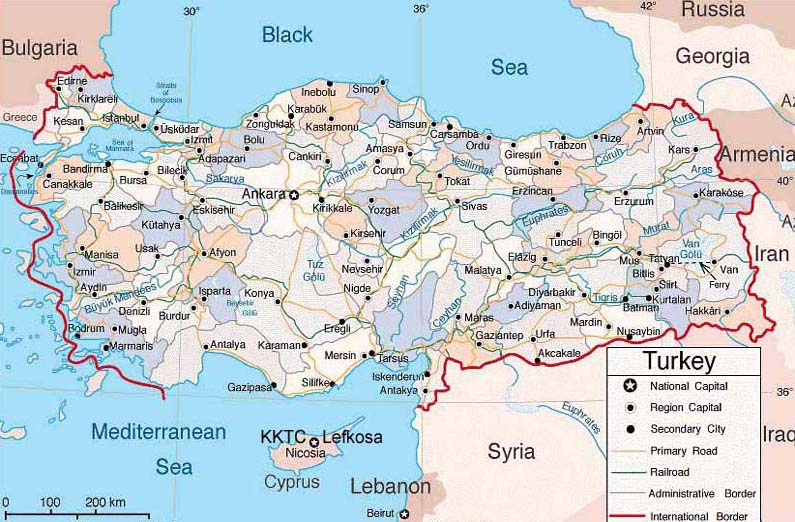
Instead of the full three-week narrative, I'll put this out there in pieces, and I'll try to consult my friends to get up some pictures up, too.
This is a story from Mardin.
By the time we arrived there, we had been traveling for about ten or twelve days, and we had been exposed to a number of new foods, many truck stops, and less than sanitary conditions. We were all ill with something, and I was taking my turn with a stomach illness.
An Istanbullu friend had insisted we contact his family in Mardin, when we got there. On the day in question, a brother-in-law was giving us a tour of a Syrian Orthodox church, The Fourty Martyr's Church (click here for a crappy panoramic tour).
When I see churches in Europe, 'opulent', 'excessive', and 'huge', are all words that come to mind. I hear the message they tried to send to the infidel:
"Our God is a really, really big God, and he can squish you."On the other hand, this church is older, by about five hundred years, than the oldest that I saw in Christendom. It spoke to me that day, three years ago, a message about community, tolerance, peace, and clean bathrooms.
I excused myself from our tour and entered the immaculately white-tiled restroom. Windows, carved into the rock above, illuminated the interior, and while walking through, the contrast of light and shadow danced in the room and from the mirrors. I checked each stall, as I am prone to do with an upset stomach, and found that there were no European-style toilets.
This was a squatty-potty day and it would be messy.
Diarrhea doesn't negotiate, really, so I counted myself lucky to have found a tiled hole, measured against the very real alternative of shitting my pants.

Skipping the details, lets just say I was happy to have gotten up and out of that situation having only soiled my hands. There wasn't any toilet paper, and if you check the picture, you'll notice the faucet at about knee-height next to the toilet. That's a pretty typical feature in Turkish toilet facilities, the idea being that water is cleansing. Indeed it is, and even though I had a wet bum, the alternative was, again, far more uncomfortable. I find that I am often willing to accept a poor option when the only alternative is a horrifying option. Given my overall feeling of discomfort and ickyness, I was really looking forward to a good hand-scrubbing.
I have a former room mate that consistently pointed out to me, that Europeans use paper on their backsides and that this doesn't clean everything. He always joked about European people, referring to them as "shitty-asses". It was cute, and I never bothered to mention that the bidet has a silent "t" because it is a French invention. In any event, water is a big part of Turkish backside-cleansing culture. Use a squatty-potty often enough, and one can learn to enjoy the intimate interaction with one's 'down-theres' that the quest for true cleanliness entails.
As I approached the sink, my heart, dare I say it, felt as though it had been flushed. In front of me were five immaculate sinks (again, there was the light and all that). Each sink had a soap dish, carved into the marble counter, and above each, on the wall, were attached plastic soap dispensers.
All shone with that shiny newness that accompanies never having held soap.
Wednesday, June 25, 2008
My friend, the carpet dealer, isn't going to like this...
Most third world countries, after being stripped of natural resources or independent financial markets (through various forms of imperialism), turned to tourism as a means to bring money into their suffering economies. There are hundreds of examples of this, so I'll leave it in the intrepid hands of the curious to study the cases themselves, but for the point of this story, it's important to understand that Turkey is one such country.
In an effort to better receive foreign visitors, Turkey has opened vocational high schools specializing in tourism, hotel management, and translating. Millions of dollars have been spent improving transportation in the areas tourists are most likely to visit, and the advertising effort has likewise cost millions.
Every part of the culture is up for sale: carpets, Ottoman style clothes, tickets to view Dervish religious ceremonies, and even Kurdish head scarves (a political symbol now turned fashion statement).
Turkey has probably done much more to attract tourists, but I'm not a tourist, so I don't really know. I live here. When I travel, I usually hitch-hike, stay with friends or in shitty motels, and eat stuff I buy at local markets. My knowledge of the industry is mostly limited to what I've read about in the papers or heard from friends. I haven't even been inside the Blue Mosque, and I've lived here for 3 years.
I could criticize the problem further, but like I said, I don't really know... Instead, the observation of my friend, the carpet seller, seems to sum up the main problem with this situation.
"If tourists don't come, or can't come, they don't buy the wares that pay my bills. So, I can't spend money in my economy on the things I need and want."
This was in 2004, when the tourism industry in Turkey was still suffering from post-September 11th fallout: people still too afraid to travel to a "Muslim" country.
Now, there's a worse problem... people just can't afford to do it. The link visits an image tracking Americans' projected travel plans since 1968. This year has brought the lowest figure in four decades. I wish I could find the same data for Europeans.
Carpet sales will probably decline, and I suppose I shouldn't expect any visitors, either. Those who still wish to travel might find these links helpful:
For the penniless
For the homeless
In an effort to better receive foreign visitors, Turkey has opened vocational high schools specializing in tourism, hotel management, and translating. Millions of dollars have been spent improving transportation in the areas tourists are most likely to visit, and the advertising effort has likewise cost millions.
Every part of the culture is up for sale: carpets, Ottoman style clothes, tickets to view Dervish religious ceremonies, and even Kurdish head scarves (a political symbol now turned fashion statement).
Turkey has probably done much more to attract tourists, but I'm not a tourist, so I don't really know. I live here. When I travel, I usually hitch-hike, stay with friends or in shitty motels, and eat stuff I buy at local markets. My knowledge of the industry is mostly limited to what I've read about in the papers or heard from friends. I haven't even been inside the Blue Mosque, and I've lived here for 3 years.
I could criticize the problem further, but like I said, I don't really know... Instead, the observation of my friend, the carpet seller, seems to sum up the main problem with this situation.
"If tourists don't come, or can't come, they don't buy the wares that pay my bills. So, I can't spend money in my economy on the things I need and want."
This was in 2004, when the tourism industry in Turkey was still suffering from post-September 11th fallout: people still too afraid to travel to a "Muslim" country.
Now, there's a worse problem... people just can't afford to do it. The link visits an image tracking Americans' projected travel plans since 1968. This year has brought the lowest figure in four decades. I wish I could find the same data for Europeans.

Carpet sales will probably decline, and I suppose I shouldn't expect any visitors, either. Those who still wish to travel might find these links helpful:
For the penniless
For the homeless
Tuesday, June 24, 2008
Ankara: A taxi driver's advice
This didn't happen to me, but a German-Turk (we'll call him Ahmet), also living in Ankara temporarily, told me this story about his arrival...
With two German colleagues, all piled into a taxi and driving from the airport to the hotel, Ahmet struck up a conversation with the driver. Ahmet was the only Turkish speaker of the three of them, and having grown up in Germany, didn't know his way around Ankara. As they wrapped up the formalities, his colleague interrupted to ask about attractions in the city, things to go, see, and do. Ahmet translated the question.
The driver went silent and thought for a minute...
And another minute...
And another...
In German, the colleague asked Ahmet, "What did you say to him?"
Then the driver suddenly burst out, "Ah, I know. You can go to the zoo!"
With two German colleagues, all piled into a taxi and driving from the airport to the hotel, Ahmet struck up a conversation with the driver. Ahmet was the only Turkish speaker of the three of them, and having grown up in Germany, didn't know his way around Ankara. As they wrapped up the formalities, his colleague interrupted to ask about attractions in the city, things to go, see, and do. Ahmet translated the question.
The driver went silent and thought for a minute...
And another minute...
And another...
In German, the colleague asked Ahmet, "What did you say to him?"
Then the driver suddenly burst out, "Ah, I know. You can go to the zoo!"
Tuesday, June 17, 2008
My trip to Bulgaria...
This was written on March 26, of this year. I am posting this here because it so accurately characterizes many of my previous travel experiences in Turkey, and it does so from the perspective of having anticipated the trip's failure (which was, at the time, a first). I'll make an effort to post a, yet unwritten, follow-up of the actual trip.
26.03.2008, 11:27
Those of you who knew that I was going to Bulgaria this morning will find it odd that I've already completed a story about the trip. Here's the secret to my celerity: I missed my bus.
Actually, the service shuttle, that should have taken me to the bus station, left me behind.
This morning is one that started yesterday evening with the prediction, to my room mate Emrah, that I would "wait in the appointed place, at the appointed time" and still miss the shuttle, which would be both late and somewhere else. This sort of thing happens often enough, to me, that I've become good at predicting not merely that something will go wrong, but also the manner in which it will go wrong.
In fact, I even explained to Emrah, that there would be an argument with the driver, or the person who issued my ticket, or someone else, who would tell me that I had misunderstood/been late/been in the wrong place... which is to say, that I was wrong, and not the people or person who gave me poor instructions or didn't show up on time. Blaming the victim is popular in Turkey, too.
So, at 7:20, with all the optimism of a person heading to Bulgaria for three hours, and a packed lunch and books I wouldn't read, and looking forward to falling asleep as soon as I was on board, I waited across the street from the Boğaziçi University South Campus gate. This is important, because last night, both the person who issued my ticket and myself spoke to the service shuttle driver, and we each confirmed twice (four times total) that the shuttle would pick me up across the street from the Boğaziçi University South Campus gate at 7:20.
At 7:25, I knew that I would not be picked up and that I would miss my bus. It wasn't fatalism or pessimism, but experiential knowledge informed by many missed buses, only a few of which I can claim responsibility for.
Still I waited. Despite knowing I was stuck, I chose hope, and remained at the corner, across from the Boğaziçi University South Campus gate for another ten minutes. This impulse to reject one's fate is, perhaps, one of the more peculiar features of the human experience (I could, but prefer not to, cite a list starting with Global Warming and the Iraq War, but alas, time). I waited, consciously yielding to the Fates, but also having no other course of action in mind.
I was also pissed. I never have fun when I'm right about something... which is to say that I am right about only the wrong things.
At 7:35, I dabbled in reversing destiny. Also, I had gotten bored of waiting and knew I would be awake for several more hours (I'm not a morning person, so this is a rare day). I ran home, had Emrah call the bus company, and we both spoke to a man yelling about the shuttle, that it definitely passed Boğaziçi University, but that I shouldn't be waiting there anyway, because the service shuttle leaves from a place nearby there, a "yazı hane", which is a local bureau office. I should emphasize the yelling and the tone, both of which implied that I was a fool, but were additionally difficult to understand. It was at this point that I began to feel victimized.
On Emrah's advice (which I love, because he uses the phrase "As much as I know..." to introduce facts about which he is unsure, although they are almost always correct) I sought out the departure point for the MetroTurizm shuttle bus, and found only a sign and an empty parking spot. The place is less than 100 meters from South Campus, but it is in no way across from the gate, nor visible from there. On the way there, I think I saw the MetroTurizm shuttle disappearing around a bend... can't be too sure though. I jumped at every shuttle that came by this morning, which was a lot of jumping. Shuttles exist for schools and companies and large workplaces, and it seems all of them use the same orange and blue logos and have the word "Turizm" written on them somewhere.
I called the bus company again, with my last phone credits. They connected me to the same man I had spoken with before, who I thought was the shuttle driver. In a breath, he was yelling at me again, and I realized something: When an adult yells at me I really don't like it, because I both feel I'm being treated like a child, and also that the person is absurd (and therefore, probably wrong about whatever information or situation has led them to yell). When I'm yelled at in a foreign language, however, these feelings are coupled with the knowledge that I probably won't understand what is said, and that I am also helpless to have any good comeback or means to assert myself. In Turkish, I can jump from polite, daily language, to swears that Turkish sailors don't use, but I lack the acceptable middle-ground for this sort of a situation.
So, I just got louder and told the man not to speak to me that way, and to stop yelling. At the same time, I thought about the various curses I learned at Beşiktaş matches, things to say about his mother and her affinity for the village donkeys and traveling bands of gypsies. It ended up, that telling him not to yell was sufficient to sate my ego.
I hung up the phone, and got on a city bus heading for Taksim. I figured that, while I was awake, getting my ticket changed would be wise. When the bus got to Beşiktaş, it occurred to me that, rather than go all the way to Taksim, I could go into the office there, which is exactly what I did once I peeled myself out of the bus (rush hour gets crowded here).
The man behind the desk was on the phone, and he had a familiar voice and manner. When he got off the phone, I began my rehearsed explanation for needing a new ticket. He cut me off to clarify that I needed a new ticket, and asked if I was coming from Etiler. At about the same moment, we both realized that we had each yelled at the other over the telephone.
He began yelling about the "yazı hane" before I could react. Taken off guard, and now face to face with the man who had harshed my traveler's mojo, I did something uncharacteristic. I started humbly explaining that this was no way to speak to customers, much less foreign guests of his country. In fact, I asked if he always yelled at people this way. I went on to say that I had spoken with the driver the night before, and been in the right place at the right time, that I didn't want his explanations because I had found the "yazı hane", and I just wanted the same ticket for the next day.
He stopped yelling, became polite and, more importantly, quiet, and issued my ticket.
It all happened in Turkish, haltingly, but still, it felt pretty damn good.
Tomorrow morning, at 7:20, I'll be leaving from the Etiler bureau office by a service shuttle to the central bus station. I'll tell you about it when I get back.
26.03.2008, 11:27
Those of you who knew that I was going to Bulgaria this morning will find it odd that I've already completed a story about the trip. Here's the secret to my celerity: I missed my bus.
Actually, the service shuttle, that should have taken me to the bus station, left me behind.
This morning is one that started yesterday evening with the prediction, to my room mate Emrah, that I would "wait in the appointed place, at the appointed time" and still miss the shuttle, which would be both late and somewhere else. This sort of thing happens often enough, to me, that I've become good at predicting not merely that something will go wrong, but also the manner in which it will go wrong.
In fact, I even explained to Emrah, that there would be an argument with the driver, or the person who issued my ticket, or someone else, who would tell me that I had misunderstood/been late/been in the wrong place... which is to say, that I was wrong, and not the people or person who gave me poor instructions or didn't show up on time. Blaming the victim is popular in Turkey, too.
So, at 7:20, with all the optimism of a person heading to Bulgaria for three hours, and a packed lunch and books I wouldn't read, and looking forward to falling asleep as soon as I was on board, I waited across the street from the Boğaziçi University South Campus gate. This is important, because last night, both the person who issued my ticket and myself spoke to the service shuttle driver, and we each confirmed twice (four times total) that the shuttle would pick me up across the street from the Boğaziçi University South Campus gate at 7:20.

At 7:25, I knew that I would not be picked up and that I would miss my bus. It wasn't fatalism or pessimism, but experiential knowledge informed by many missed buses, only a few of which I can claim responsibility for.
Still I waited. Despite knowing I was stuck, I chose hope, and remained at the corner, across from the Boğaziçi University South Campus gate for another ten minutes. This impulse to reject one's fate is, perhaps, one of the more peculiar features of the human experience (I could, but prefer not to, cite a list starting with Global Warming and the Iraq War, but alas, time). I waited, consciously yielding to the Fates, but also having no other course of action in mind.
I was also pissed. I never have fun when I'm right about something... which is to say that I am right about only the wrong things.
At 7:35, I dabbled in reversing destiny. Also, I had gotten bored of waiting and knew I would be awake for several more hours (I'm not a morning person, so this is a rare day). I ran home, had Emrah call the bus company, and we both spoke to a man yelling about the shuttle, that it definitely passed Boğaziçi University, but that I shouldn't be waiting there anyway, because the service shuttle leaves from a place nearby there, a "yazı hane", which is a local bureau office. I should emphasize the yelling and the tone, both of which implied that I was a fool, but were additionally difficult to understand. It was at this point that I began to feel victimized.
On Emrah's advice (which I love, because he uses the phrase "As much as I know..." to introduce facts about which he is unsure, although they are almost always correct) I sought out the departure point for the MetroTurizm shuttle bus, and found only a sign and an empty parking spot. The place is less than 100 meters from South Campus, but it is in no way across from the gate, nor visible from there. On the way there, I think I saw the MetroTurizm shuttle disappearing around a bend... can't be too sure though. I jumped at every shuttle that came by this morning, which was a lot of jumping. Shuttles exist for schools and companies and large workplaces, and it seems all of them use the same orange and blue logos and have the word "Turizm" written on them somewhere.
I called the bus company again, with my last phone credits. They connected me to the same man I had spoken with before, who I thought was the shuttle driver. In a breath, he was yelling at me again, and I realized something: When an adult yells at me I really don't like it, because I both feel I'm being treated like a child, and also that the person is absurd (and therefore, probably wrong about whatever information or situation has led them to yell). When I'm yelled at in a foreign language, however, these feelings are coupled with the knowledge that I probably won't understand what is said, and that I am also helpless to have any good comeback or means to assert myself. In Turkish, I can jump from polite, daily language, to swears that Turkish sailors don't use, but I lack the acceptable middle-ground for this sort of a situation.
So, I just got louder and told the man not to speak to me that way, and to stop yelling. At the same time, I thought about the various curses I learned at Beşiktaş matches, things to say about his mother and her affinity for the village donkeys and traveling bands of gypsies. It ended up, that telling him not to yell was sufficient to sate my ego.
I hung up the phone, and got on a city bus heading for Taksim. I figured that, while I was awake, getting my ticket changed would be wise. When the bus got to Beşiktaş, it occurred to me that, rather than go all the way to Taksim, I could go into the office there, which is exactly what I did once I peeled myself out of the bus (rush hour gets crowded here).
The man behind the desk was on the phone, and he had a familiar voice and manner. When he got off the phone, I began my rehearsed explanation for needing a new ticket. He cut me off to clarify that I needed a new ticket, and asked if I was coming from Etiler. At about the same moment, we both realized that we had each yelled at the other over the telephone.
He began yelling about the "yazı hane" before I could react. Taken off guard, and now face to face with the man who had harshed my traveler's mojo, I did something uncharacteristic. I started humbly explaining that this was no way to speak to customers, much less foreign guests of his country. In fact, I asked if he always yelled at people this way. I went on to say that I had spoken with the driver the night before, and been in the right place at the right time, that I didn't want his explanations because I had found the "yazı hane", and I just wanted the same ticket for the next day.
He stopped yelling, became polite and, more importantly, quiet, and issued my ticket.
It all happened in Turkish, haltingly, but still, it felt pretty damn good.
Tomorrow morning, at 7:20, I'll be leaving from the Etiler bureau office by a service shuttle to the central bus station. I'll tell you about it when I get back.
Subscribe to:
Posts (Atom)